
Ford · Lincoln
We don’t just tune,we recalibrate.
Unleashed Tuning × VanDeYacht Motorworks. Ford and Lincoln powertrain recalibration, written on PCMTec with full access to the factory PCM.
We work with the PCM, not against it. Drivability, the factory safety systems and drivetrain protection stay in place.
Together
Tuning and parts
Unleashed Tuning
Over two decades of Ford tuning. Unleashed Tuning supplies the devices, power packages and parts for these platforms, and an existing Unleashed tune is where a car’s PCMTec recalibration can start.
unleashedtuning.comPCMTec recalibration
VanDeYacht Motorworks
Powertrain recalibration for every platform on this site, each developed on multiple cars. VanDeYacht Motorworks also supports shops and individuals working in PCMTec.
Tuning supportProducts
Performance Recalibration
Refined on your car through revisions made from your logs.
$400-$600by transmission → 02 Option on any recalibrationCustom OS
Adds on-the-fly switchable maps, launch control or antilag, and flex fuel support to a recalibration.
add$600any platform →Process
A recalibration is not one file.
Base file
Usually ready in 5-7 business days, with instructions for what to log.Revisions
Send a log and a few notes on how the car drives. A revised file usually comes back in 3-5 business days.How many
Seven to ten rounds is normal, and some cars need more.Your car
No match. Send the year, model, engine, transmission and strategy code to customer support for a quote.
Search by model, engine or transmission.
Recalibrations
Ford & Lincoln
Every platform we recalibrate, with its price. Automatics cost more because the transmission is recalibrated too.
Not listed? Send the year, model, engine, transmission and strategy code to customer support for a quote.
Custom OS
Customizable OS features.
An optional PCMTec operating system for your recalibration, ordered with it or added later for the same price.
Features
On-The-Fly Switchable Maps
Up to four maps, selected with the cruise control buttons.
Launch Control or Antilag
Fully integrated into the factory cruise control system, with no aftermarket modules. Your file has launch control or antilag, whichever you choose.
Flex Fuel Support
The flex fuel map allows the PCM to dynamically adjust for ethanol blends. No need to reflash when switching fuels.
Using it
PCMTec’s Custom OS works through the instrument cluster and the cruise control buttons, for simple, on-the-fly control of advanced PCM features.
Showing the menu
Switching maps
- Press Cancel. The tach shows the active map: 1,000 rpm for Map 1, 2,000 for Map 2, 3,000 for Map 3 and 4,000 for Map 4.
- Select a map with the + and - speed buttons.
- Press Cancel again to confirm.
Launch control or antilag
Your file can have one of the two. Launch control does not work from a roll, and antilag is less optimized for a launch.
Launch control
- Hold the cruise On/Off button and press the brake.
- Floor the accelerator.
- Release On/Off, keeping the brake and the accelerator down.
- Release the brake to launch.
Antilag
- Hold the cruise On/Off button.
- Floor the accelerator.
- Release On/Off, keeping the accelerator down.
Variable Launch RPM, optional
- Press Cancel, as you would to switch maps, and go below Map 1.
- The tach shows the launch rpm. Adjust it with the + and - speed buttons.
- Press Cancel to exit.
Ordering
Choose your platform, then the configuration with Custom OS.
Process
How a file is built.
A recalibration is not one file. It is a base file, then revisions made from logs of your car.
The loop
Once
Order
The order form asks for the fuel, VIN and modifications, plus, if you have them, the strategy code, your device and, for an SCT X4, its serial. Your ticket opens with the order.
Base file
Your first file, with instructions for what to log.
Each round
Drive and log
Load the file with your SCT X4 or OBDX Pro FT, drive the car, and record a log as instructed.
Send the log
Send the log back with a few simple notes on how the car drives.
Revised file
A revised file comes back, with any notes for the next drive.
Rounds repeat until the car is right.
Your ticket
Each car has its own ticket, with every file, log and message for it.
Sending logs
Reply to any email about the ticket with the log attached, or upload it on the ticket page. Video and large files go through the page.Finding files
Sign in under Your tickets with the email you ordered with.Development
Our process carries across all modern Fords, so multiple models are always in development. We also work on multiple cars from each platform, to get the most performance and longevity out of each one.
Changing hardware
New hardware means the recalibration has to be reworked, which is billed as new work. Revisions for parts bought from Unleashed Tuning or VanDeYacht Motorworks are free.
Tools
E85 calculator
Work out the ethanol content of a blend, or how much E85 to add to reach a target.
Pump E85 varies. A tested number is the most accurate.
Ethanol content
Pump E85 varies. A tested number is the most accurate.
E85 to add
Fill points
| Fill to | Fuel in tank | E85 to add | Gas to add | Ethanol |
|---|
Customer support
Open a ticket.
Revisions and questions for a car running a UT × VM recalibration, and quotes for a car that is not listed. If the car already has a ticket, reply to any of its emails instead.
New ticket
Ticket opened
A copy is on its way to your email. Reply to it to add anything else.
Your tickets
See every ticket, file and message. Sign in with the email you ordered or opened a ticket with.
View your ticketsTuning support
For shops and individuals working in PCMTec on their own files.
Open a requestReference
Frequently asked
If something here does not cover it, open a ticket and ask.
The recalibration Custom OS Ordering and revisions Changes and updates Your account Legal & policy
The recalibration
Which vehicles do you recalibrate?
Ford and Lincoln, on PCMTec. Every platform we have developed is listed with its price on the recalibrations page.
If yours is not there, send the year, model, engine, transmission and strategy code to customer support and we will tell you where it stands.
What does it cost?
A recalibration is $400 on a manual and $600 on an automatic, because automatics include transmission recalibration. The GT500 with its DCT is $500.
Custom OS adds $600 on any platform.
How are your PCMTec files different from a regular tune?
Factory calibrations are designed for the widest range of drivers and conditions. Comfort, efficiency and long-term reliability in commuter use come first, so the engine and transmission strategies often lean toward higher slip, softened torque transitions and aggressive power reduction as charge temperatures rise. Those choices suit daily drivers, but they limit precision and consistency once you ask more of the vehicle.
We work with OEM-level access, recalibrating the engine, and the transmission on automatics, to perform with greater accuracy under higher loads while preserving the protections that keep your powertrain safe.
Transmission recalibration
- Converter and clutch strategies are optimized to reduce unnecessary slip, lowering friction and heat while improving torque-holding capacity. That improves reliability under load and reduces parasitic losses, so power delivery feels more direct.
- Shift execution is sharpened for faster, more predictable gear changes under load, with carefully profiled pressure curves to avoid harshness at light throttle.
- Adaptive learning and KAM, the keep alive memory where the PCM stores what it has learned, are re-aligned for higher torque, so the transmission keeps adapting intelligently instead of mislearning at elevated power.
- Torque truncation and spark cut events are recalibrated for precision, balancing component protection with minimal interruption to acceleration. That keeps the connected feel while still managing stress on clutches and shafts.
Why smooth shifts aren’t always better →
Engine recalibration
- Airflow, torque and fueling models are recalibrated from the ground up, so torque delivery is precise and consistent with how the engine actually behaves, rather than capped or scaled estimates.
- Torque management is kept and tuned for accuracy. Instead of disabling interventions, we restructure spark and air torque reductions to engage progressively and predictably, protecting drivetrain components without robbing forward thrust.
- Charge temperature and density effects are balanced. Power does taper as temperatures rise, but at a measured rate that maintains drivability, guards against detonation and preserves thermal headroom, unlike the abrupt reductions in the factory strategy.
- Fueling and knock strategies are refined to safely maximize cylinder pressure, for consistency every day and headroom for performance use across variable fuel quality and atmospheric conditions.
What hot charge air costs an EcoBoost →
Our philosophy
Every recalibration we create is deliberate, precise and tailored. Safeties stay in place, consistency is preserved, and the vehicle simply works the way it should: sharper, stronger and more predictable. We don’t cut corners. We don’t copy files. We build them right from the start.
My vehicle already has an Unleashed tune. How does the conversion work?
We start by reading out or converting your existing Unleashed tune, to keep the proven elements you already like. From there, we build on it with PCMTec’s full access, using extensive datalogging to tailor everything to your hardware, environment and driving goals.
What fuels can it run?
Your recalibration is built for the fuel you tell us when you order. To switch between ethanol blends without reflashing, Custom OS adds flex fuel support.
The E85 calculator works out the ethanol content of a blend, or how much E85 to add to reach a target.
Custom OS
What is Custom OS, and do I need it?
An optional operating system for your recalibration, controlled from the cruise control buttons and the cluster. It adds on-the-fly switchable maps, launch control or antilag, and flex fuel support.
No. A recalibration is complete without it. How Custom OS works →
Launch control or antilag?
Your file can have one of the two, whichever you choose. Launch control does not work from a roll, and antilag is less optimized for a launch. How to use each →
Can I add Custom OS later?
Yes, for the same $600, to any PCMTec recalibration from us.
Ordering and revisions
What do you need from me to start?
The fuel, the VIN and the powertrain modifications, plus, if you have them, the strategy code, your device and, for an SCT X4, its serial. The order form asks for all of it.
Which devices are supported?
SCT X4 and OBDX Pro FT. Files arrive as a download and you load them with the device, so the car never needs to come to us.
An OBDX Pro FT can be used on any number of cars. An SCT X4 stays locked to the car it flashes.
What happens after I order?
Your order opens a ticket under your email, and you get an email with it. The base file comes next, with instructions for what to log, and revised files follow from your logs until the car is right. The whole process →
How long does a base file take?
The base file usually takes 5-7 business days, and each revision 3-5. Messages are usually answered within 3 business days.
How many revisions are included?
As many as the car needs on its current hardware. Seven to ten rounds is normal, and some cars need more.
What do I do during revisions?
Load each file with your device, drive the car, record a log as the instructions describe, and send it back with a few notes on how the car drives.
To send a log, reply to any email about your ticket with the log attached, or upload it on the ticket page. Video and large files go through the page.
Your account
How do I sign in?
Your account is the email you ordered or wrote to us with. Sign in at Your account with that email and your password, or have a sign-in link emailed to you.
The first time, use the emailed link and agree to the site terms. Then set a password on your account page. Tick Remember me to stay signed in on your own device.
I forgot my password.
Use Forgot password on the sign-in page. A link to set a new one goes to your email and works once, within 30 minutes. Setting a new password signs out every other device.
Where do I find my files?
In Your account. Every file sent to you, and every file you sent, is listed there with your orders and vehicles, and each one is also on its ticket with the messages around it.
Is my account secure?
Your password is never stored, only a protected fingerprint of it, and a password found in a known data breach is refused. After a few wrong tries, signing in with a password pauses for 15 minutes. If you ever signed in on a device that is not yours, use Sign out on every device on your account page.
Changes and updates
What happens when I change hardware?
The recalibration is reworked for the new hardware as new work, because the file was built for the car as it was.
Revisions for parts bought from Unleashed Tuning are free.
Where do I buy parts?
Unleashed Tuning sells tuning devices, power packages, intake, exhaust, fuel and cooling parts for the platforms we recalibrate.
Can I move the recalibration to another car?
No. Each recalibration is written for one car, so a second car needs its own.
What if a dealer updates the PCM?
If a dealer update stops the recalibration from working, it can be transferred to the updated PCM for a fee that is less than a new recalibration. Some cases are able to be transferred without the fee. Open a ticket to arrange it.
Can I go back to stock?
Yes. We can provide a factory file on request through customer support.
Legal & policy
Emissions and compliance
We do not tune any vehicle with emissions equipment removed, and we do not provide recalibrations that disable, bypass, or interfere with emissions control systems. We also do not sell tuning devices or recalibrations for vehicles registered in California.
Beyond that, you are responsible for making sure the configuration you order, and the way you use the vehicle, comply with the rules that apply to you.
Will this affect my factory warranty?
A manufacturer or dealer may decline a warranty claim on a recalibrated vehicle. Whether any particular claim is accepted is between you and them, and it is outside our control. We make no promise about how a dealer will treat your vehicle, and we do not reimburse claims that are declined.
Sales tax
We do not charge sales tax outside of Wisconsin.
Depending on where you live, your state or country may have its own tax rules for purchases like this. Your local tax authority can tell you what, if anything, applies.
Refunds
All sales are final, because each recalibration is custom work for one car. The revisions needed to get it right are part of the order, so if something is off, raise it on your ticket.
Full detail is in the refund policy.
Notes
Technical notes.
Intercoolers, spark plugs and transmission shifts, worked through with the physics shown and the sources listed.
Technical note
Why “smooth” transmission shifts aren’t always better
A smooth automatic shift stretches out the time a clutch spends slipping. Slip turns energy that would otherwise reach the wheels into heat in the clutch and the fluid, so a shorter, firmer shift, with engine torque briefly reduced, puts less heat into both.
Jake VanDeYachtFirst published August 2025Revised September 2026
How an upshift works
People often describe a great automatic transmission as smooth, with gear changes that are barely noticeable. That is often what manufacturers aim for, and it comes at a cost. If the goal is power handling, longevity or track response, a soft shift works against it.
In most modern automatics, each gear is selected by applying a combination of clutch packs, stacks of friction plates and steel plates that a hydraulic piston squeezes together. Most shifts are clutch-to-clutch: one clutch, the offgoing, releases while another, the oncoming, applies. A dual clutch transmission shifts the same way, handing torque from one clutch to the other.
Some automatics use a one-way clutch for certain shifts instead, often in first gear. A one-way clutch locks in one direction and freewheels in the other, so it holds in first and lets go on its own as the clutch for second applies. Only that one clutch has to be controlled.
An upshift happens in two phases. In the torque phase, the oncoming clutch takes over the load while the offgoing clutch lets go, and the gear ratio has not changed yet. In the inertia phase, the oncoming clutch slips while engine speed falls to match the new gear, and the shift ends when that clutch locks.
The handoff comes down to timing. If the two clutches overlap too much, both hold at once and fight each other through the gears, which is called tie-up. If they overlap too little, engine speed flares up for a moment before the oncoming clutch takes hold.
A factory calibration built for comfort deliberately overlaps the two. The offgoing clutch drags a little longer, the oncoming clutch applies a little slower, and the handoff is spread over a longer window. That is what makes the shift feel seamless.
Where the heat comes from
A clutch makes heat whenever it carries torque while its two sides turn at different speeds. That difference is its slip speed, and the energy it turns into heat is the torque it carries multiplied by the slip speed, added up over the time it slips.
- E
- Energy turned into heat in the clutch, in joules
- Tc
- Torque carried through the slipping clutch, in newton meters
- Δω
- Slip speed across the clutch, in radians per second, where 1 rpm is about 0.105
- ∫ … dt
- Added up over the time the clutch slips
In an upshift, the oncoming clutch slips from the moment it starts to take load. It slips at the full speed difference through the torque phase, then its slip falls to zero through the inertia phase. A longer handoff and a longer speed change both add heat.
The inertia phase can be worked through. Treat the rotating parts ahead of the clutch as one mass, and assume both torques hold steady and the car’s speed barely changes in the fraction of a second the shift takes. The heat then comes to:
- I
- Rotating inertia ahead of the clutch, meaning how hard the engine, torque converter and transmission input are to slow down, counted at the clutch, in kg·m²
- Δω0
- Slip speed across the oncoming clutch as the speed change begins
- Tc
- Torque the oncoming clutch carries while it slips
- Tin
- Torque arriving at the clutch from the engine
The equation has two parts. The first, ½ I Δω02, is the least heat the speed change can make while the engine is still driving the clutch, set by how hard the parts are to slow down and how much their speed has to change. It grows with the square of that speed change, which is larger the higher the engine speed at the shift.
The second part, Tc ÷ ( Tc − Tin ), multiplies that least heat because the clutch is carrying engine torque at the same time. The clutch has to carry more torque than arrives from the engine, or the engine never slows to the new speed. The closer the two are, the larger the multiplier, the longer the slip and the more heat it makes.
What the heat does
That heat works on the clutch and the fluid in three ways.
- Flash temperature. The plates truly touch only at many tiny high points. That is where the heat is made, and those points briefly run well above the temperature of the plate as a whole.
- Friction material. Prolonged slip wears the friction material and accelerates glazing, a hardened, polished surface that grips less.
- Fluid. The fluid carries the heat away, and heat speeds its oxidation, the slow reaction with oxygen that ages it. In a 2021 laboratory study, Farfan-Cabrera and colleagues found that oxidized automatic transmission fluid raised a wet clutch’s friction coefficient, its grip, and generally weakened its resistance to shudder, the vibration of plates that grab and release, which depends on friction rising as sliding speed rises.
A long, soft shift trades clutch and fluid life for refinement, and none of the energy turned into heat reaches the wheels.
Cutting the heat
The inertia is fixed by the hardware, and the speed change by the gear ratios and the engine speed at the shift. For a given shift, that leaves two things to work with in the speed change: more clutch torque, or less engine torque coming in while the clutch slips. A shorter handoff before it cuts heat as well.
A transmission asked to hold more torque, or to survive track use, needs a shorter slip and less heat. A performance recalibration often does the opposite of a factory calibration built for daily driving:
- Raise hydraulic pressure to the clutch packs, so the oncoming clutch clamps harder and stops slipping sooner.
- Shorten the overlap, so the offgoing clutch releases decisively as the oncoming clutch locks.
- Coordinate torque control with the shift, so engine speed comes down to the new gear without the clutch dragging.
More pressure means more clutch torque. How much a clutch pack can hold is:
- μ
- Friction coefficient, how much grip the plates have, set by the friction material and the fluid and changing with slip speed and temperature
- F
- Clamping force: the hydraulic pressure times the piston area, less the force of the return spring that pulls the piston back
- rm
- Effective radius of the friction faces, about halfway between their inner and outer edges
- n
- Number of friction faces
A recalibration can change only the clamping force, through pressure. Everything else comes from the hardware and the fluid, and so does the most pressure the pump and valve body can deliver.
Less engine torque coming in is the other way. Here is the same shift with the clutch torque held at 1.5 times full engine torque:
| Engine torque into the clutch | Heat, times the least | Slip time |
|---|---|---|
| Full | 3.0 | 100% |
| Half | 1.5 | 50% |
| A quarter | 1.2 | 40% |
In this example, halving the engine torque halves both the heat and the slip time, without any more clutch torque.
That is why disabling torque management is not the fastest way to firm up a shift. Torque management is the PCM and TCM, the engine and transmission computers, briefly trimming engine torque during a shift through spark timing and airflow. In stock form it is gentle, so the clutches do not shock the driveline. With no torque reduction at all, the clutch has to slow the engine while carrying full engine torque, the top row of the table. The key is to reshape torque management, so torque is cut briefly, the clutch locks quickly and cleanly, and then full power returns.
A performance recalibration can go further than stock, not by removing less torque but by removing more for a much shorter window. The speed change then takes less time and makes less heat without the clutch having to clamp harder, and the shift stays mechanically safe when pressures and timings are set correctly.
The balance
A quick shift done properly feels nothing like a harsh bang shift. It is firm and decisive without shocking the drivetrain, and it comes from coordinating:
- Hydraulic pressure curves
- Clutch overlap timing
- Clutch fill time, the moment it takes to fill the piston with fluid before the clutch starts to grip
- Torque reduction and restoration
- Fluid condition and cooling capacity
The aim is enough pressure and speed to keep heat down, without torque spikes that fatigue shafts, gears and differentials. Done well, the transmission runs cooler, the clutch packs stay healthy, and with more clamping force they hold more torque.
Sources
- Harald Naunheimer, Bernd Bertsche, Joachim Ryborz and Wolfgang Novak, Automotive Transmissions: Fundamentals, Selection, Design and Application, 2nd edition, Springer, 2011. Shift elements, one-way clutches and shifts under load.
- Richard G. Budynas and J. Keith Nisbett, Shigley’s Mechanical Engineering Design, McGraw-Hill. The torque capacity of friction clutches.
- Harmen Blok, “Theoretical study of temperature rise at surfaces of actual contact under oiliness lubricating conditions,” Proceedings of the General Discussion on Lubrication and Lubricants, volume 2, Institution of Mechanical Engineers, London, 1937, pages 222-235. Flash temperature.
- Leonardo Israel Farfan-Cabrera, Ezequiel Alberto Gallardo-Hernández, Manuel Vite-Torres and Jesús Gilberto Godínez-Salcedo, “Influence of oxidation of automatic transmission fluids (ATFs) and sliding distance on friction coefficients of a wet clutch in the running-in stage,” Friction 9, 2021, pages 401-414.
Technical note
Do you really need an intercooler upgrade on your EcoBoost?
Compressing air heats it, and hot charge air costs a turbocharged engine boost, timing and eventually power. An intercooler is judged by how close to the outside air temperature it brings that air, which is called its effectiveness.
Jake VanDeYachtFirst published August 2025Revised September 2026
How hot the air gets
A turbocharger’s compressor squeezes outside air to raise its pressure, and that added pressure is boost. Compressing air takes work, and the work ends up as heat in the air. The temperature coming out of the compressor can be estimated from how much it raises the pressure and how efficient it is:
- T1, T2
- Air temperature into and out of the compressor, on an absolute scale: °F plus 459.67, which gives degrees Rankine
- PR
- Pressure ratio: absolute pressure out divided by absolute pressure in, where absolute pressure is boost plus the atmosphere’s 14.7 psi at sea level
- η
- Compressor efficiency as a fraction, where a perfect compressor would be 1.0
- 0.286
- A property of air, (γ − 1) ÷ γ, where γ is 1.4
With 80°F outside air at sea level and a compressor at 70% efficiency, that gives:
| Boost | Pressure ratio | Out of the compressor |
|---|---|---|
| 10 psi | 1.68 | 205°F |
| 15 psi | 2.02 | 250°F |
| 20 psi | 2.36 | 295°F |
| 25 psi | 2.70 | 335°F |
| 30 psi | 3.04 | 370°F |
These are estimates. Real efficiency changes with how hard the compressor is working, and any restriction in the intake ahead of it, or pressure lost in the intercooler after it, raises the pressure ratio needed for the same boost. The scale holds either way: at 20 psi the air leaves the compressor near 300°F, and more boost makes it hotter still.
What the heat costs
Hot charge air, the compressed air on its way to the cylinders, is less dense at the same pressure, so each cylinder takes in less oxygen. It also raises the chance of knock, where the last of the fuel and air ignites on its own before the flame reaches it. The PCM detects knock with knock sensors and answers it by pulling timing, firing the spark later.
A common rule of thumb puts the cost at about 1% of power for every 10°F rise in intake air temperature. That is close to the temperature term in SAE J1349, the standard for correcting dyno results to standard air conditions. It adjusts a dyno reading for the air on the day of the test, and it does not model a turbocharged engine that controls its own boost.
The EcoBoost PCM works to a torque target. As charge air gets hotter and less dense, the turbo has to work harder to reach that target, and the PCM pulls timing and torque as temperatures climb. Heat is paid for in extra boost, turbine speed and timing, and power at the wheels falls once the turbo cannot supply the extra air, or the timing pulled costs more than the extra air returns.
Effectiveness
An intercooler is a heat exchanger that takes heat out of the charge air before it reaches the cylinders. Its effectiveness is the share of the possible temperature drop it achieves, where the most it could do is bring the air all the way down to ambient, the outside air temperature.
- Tin
- Charge air temperature going into the core
- Tout
- Charge air temperature coming out of the core
- Tambient
- Temperature of the outside air cooling it
Take air leaving the compressor at 335°F on an 80°F day. A core with an effectiveness of 0.6 delivers it at about 180°F. A core at 0.9 delivers it at about 105°F, about 25°F above ambient.
Effectiveness is not fixed. It falls as more charge air flows through the core, when less outside air crosses it, and as the core heat soaks, warming up over repeated pulls until it has less capacity left to take heat out.
Air-to-air and water-to-air
Most Ford EcoBoost engines, including those in the F-150 and the Mustang, use an air-to-air intercooler from the factory.
- Air-to-air passes charge air through a core cooled by outside air flowing across the front of the car. It is simple and reliable, and it works best while the car is moving.
- Water-to-air passes charge air through a core cooled by liquid, which needs a pump and its own coolant loop. The coolant’s thermal mass, its ability to absorb heat before its own temperature climbs, soaks up a short burst of boost well. Over a longer run the coolant warms, and the system heat soaks.
The stock core
A factory intercooler is sized for the engine’s factory output. A performance recalibration usually raises boost and airflow, so more heat goes into the same core and its effectiveness falls. On recalibrated EcoBoosts with stock cores, charge air often reaches 140-180°F or more within a few seconds of boost. The PCM then pulls timing and torque, and power at the wheels drops. Drivers often describe it as “it hits hard, then fades.”
Once a core has heat soaked, it no longer brings the air back near ambient, and the temperature going into the engine climbs toward the temperature coming out of the compressor.
What an upgrade changes
- Consistent power. A larger, more effective core holds charge air closer to ambient, and its extra mass takes longer to heat soak, so power holds after a few seconds of boost.
- Knock margin. Cooler charge air lowers the temperature of the unburned mixture, which is what raises the knock threshold. A given mass of cooler air also needs less boost pressure. Less knock helps protect the pistons and spark plugs.
- Less work for the turbo. Because the PCM works to a torque target, cooler, denser air lets the engine reach it with less boost pressure and turbine speed.
- Ethanol. Ethanol blends resist knock through a higher octane rating and the cooling they give as they evaporate. Cooler charge air adds to that margin, which allows more timing and boost.
Choosing a core
Every intercooler costs some boost pressure as air passes through it, which is its pressure drop. How much depends on the design of the core and its end tanks, the chambers at each end that spread the air across the core and collect it again, and on the flow through it. Size alone does not decide it, so a well designed larger core can cool much better without costing much more pressure.
For a recalibrated EcoBoost that sees repeated boost, an intercooler is one of the smartest upgrades for reliability and consistent power. On a lightly modified car whose charge air already stays close to ambient, a larger core has little cooling left to add, and any added pressure drop can cost more than it gives back.
Sources
- John B. Heywood, Internal Combustion Engine Fundamentals, 2nd edition, McGraw-Hill Education, 2018. Compressor temperature rise, charge density and knock.
- Theodore L. Bergman, Adrienne S. Lavine, Frank P. Incropera and David P. DeWitt, Fundamentals of Heat and Mass Transfer, Wiley. Heat exchanger effectiveness.
- SAE J1349, Engine Power Test Code, SAE International. Correcting measured power to standard inlet air conditions.
Technical note
Ruthenium spark plugs: should you use them on your EcoBoost?
NGK’s charts show the Ruthenium HX burning more consistently from one combustion cycle to the next, and growing its first flame faster than the plugs it was compared with. A faster early burn moves best-torque timing later, so best torque comes with less spark advance.
Jake VanDeYachtFirst published March 2025Revised September 2026
The plug
Boost makes the mixture in the cylinder denser, and a denser mixture takes more voltage to jump the spark plug gap. That is why EcoBoost engines, particularly under high boost, place high demands on the ignition system, and why the NGK Ruthenium HX is a plug worth evaluating for them.
The electrodes are the metal tips the spark jumps between, and NGK makes the Ruthenium HX in two electrode designs. PSPE, a projected square platinum electrode, is the one NGK recommends for turbocharged and supercharged engines. DFE, a double fine electrode, is recommended for engines without a turbo.
NGK’s own charts show two tests of the Ruthenium HX, one of combustion stability and one of flame kernel growth. Each shows something useful, and each leaves something out.
Combustion stability
The combustion pressure test charts the pressure in the cylinder as a band, for the Ruthenium HX and for a plug NGK labels conventional. NGK marks the Ruthenium HX band as little dispersion and the conventional plug’s as more, and the conventional band is wider at the peak.
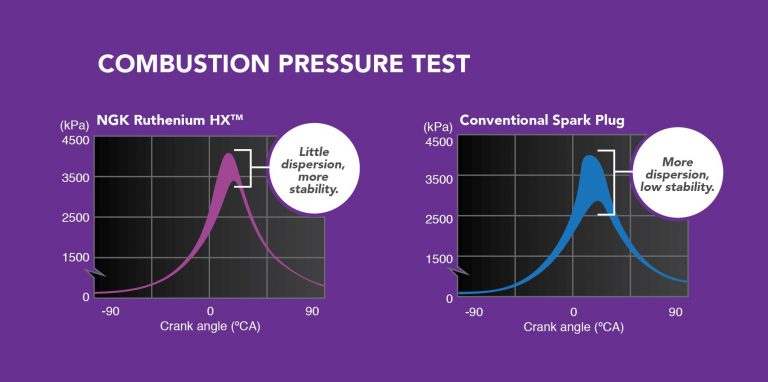
A narrower band means less variation from one cycle to the next. Engineers measure it as the coefficient of variation of IMEP, where IMEP, the indicated mean effective pressure, is the work each cycle does on the piston expressed as an average pressure. It matters because ignition timing has to be safe for the fastest-burning cycles, which are the ones most likely to knock. The less the cycles vary, the closer timing can sit to its best on average, and the more even the torque.
NGK gives no engine, speed or load for this test. Both plugs peak near 4,000 kPa, about 580 psi, far below the peak pressure a boosted direct injection engine reaches at full load. The chart shows how consistent each plug was at that test point, not how either behaves at wide open throttle on boost.
Flame kernel growth
The spark starts a small ball of flame, the flame kernel, which grows into the flame that burns the rest of the mixture. NGK’s photos show the kernel at ignition and at 1, 2 and 3 milliseconds after it, for the Ruthenium HX, an iridium plug and a nickel plug.
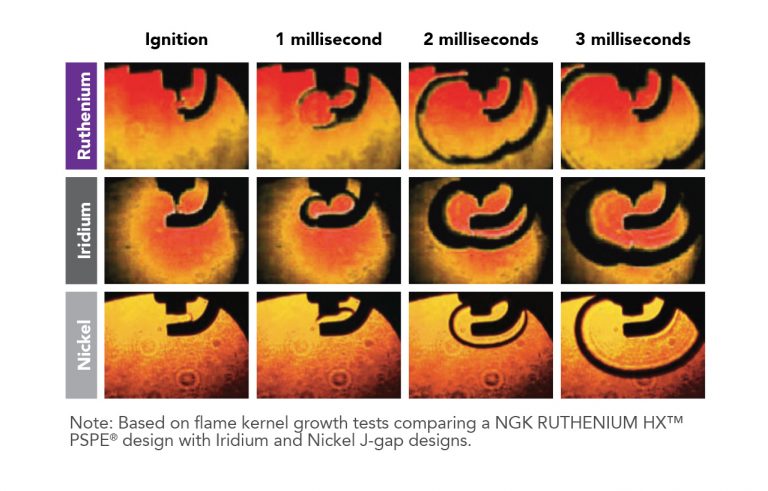
At 2 milliseconds the Ruthenium HX kernel is about the size the iridium and nickel kernels reach at 3 milliseconds. A millisecond matters here: at 3,000 rpm the crankshaft turns 18 degrees in one. A flame that grows faster in its first milliseconds brings peak cylinder pressure sooner after the spark.
The comparison changes the electrode design as well as the tip material, so the photos show the plug as a whole. They do not separate how much of the difference comes from ruthenium.
What it means for timing
Spark timing is how far before top dead center the plug fires, measured in degrees of crankshaft rotation. Best-torque timing, MBT, is the timing that puts peak pressure where the piston turns it into the most torque. When the burn starts faster, peak pressure arrives sooner, so MBT moves later and less spark advance is needed to reach it.
This matches what I have seen in logs. Final timing often reads slightly later with the Ruthenium HX, while torque output and peak achievable air load, the air each cylinder can take in, hold steady or improve. The later timing is not a sign of knock or lost efficiency. It reflects the faster burn and the pressure curve moving with it.
Which effect matters more depends on the fuel. On gasoline at high boost, timing is usually limited by knock rather than set at MBT, so the steadier combustion matters most. Ethanol blends resist knock well enough that timing can often reach MBT, so there the later MBT matters most. Either way, the differences are small.
Sources
- Ruthenium HX spark plugs, NGK Spark Plugs. The electrode designs and what each is recommended for. The pressure chart and flame kernel photos are NGK’s.
- John B. Heywood, Internal Combustion Engine Fundamentals, 2nd edition, McGraw-Hill Education, 2018. Spark timing and MBT, flame development, cycle-to-cycle variation and knock.
Not found
That page does not exist.
The link may be old, or it may have a typo in it.
Legal
Terms and Conditions
Effective date: September 19, 2026
Terms
These terms cover your use of www.UTxVM.com, your account, and anything you buy from Unleashed Tuning × VanDeYacht Motorworks. By using the site, signing in to your account, placing an order, or installing a file we supply, you agree to them.
1. Using the Website
Please use the site lawfully. When you use it, please don't:
- Misuse the site or interfere with how it runs
- Try to reach parts of the site you aren't meant to access
- Use the site in a way that could harm Unleashed Tuning × VanDeYacht Motorworks or the people who use it
2. Your Account
Your account holds your orders, files, and messages with us, under the email address you order or write to us with. You sign in with a link we send to that address, so anyone who can open your email can open your account. Please keep your email secure, and tick Remember me only on a device that's yours.
The first time you sign in, and again after these terms change, you'll be asked to agree to them. You agree that we can send you order, ticket, and account messages by email, and that they count as written notice. We may suspend or close an account that's being misused.
3. Services and Content
We provide powertrain recalibration services, informational content, and digital products. A recalibration is custom work made for one specific vehicle, based on the information you give us and the data you send back during revisions. It isn't a physical good or a stock item.
4. Your Vehicle
Every recalibration is written for the vehicle you describe, so a good result depends on a few things from you:
- The vehicle is mechanically sound and well maintained before a file goes on, and it stays that way
- The details you give us are complete and correct, including the VIN, strategy code, device and serial, fuel, and every powertrain modification
- You let us know when anything changes, including hardware, fuel, or how the vehicle is used
- Files go only on the vehicle they were written for, using a supported device
- You follow the instructions that come with a file, including anything about fuel, monitoring, or logging
- If the vehicle behaves in a way you didn't expect, a warning light comes on, or a fault code is stored, you stop driving it and contact us
We work from what you tell us. We can't inspect your vehicle, so we don't verify its condition, its hardware, or the details you report.
5. Risk
Any change to a vehicle's powertrain carries some risk. Engines, transmissions, and driveline parts can fail, and a modified vehicle can behave differently from a stock one. Mechanical condition, fuel quality, maintenance, hardware, driving style, and use all play a part, and those are outside our control.
By ordering, you accept that risk. The decision to modify your vehicle, and how it is driven afterwards, are yours.
6. Emissions and Compliance
We don't tune any vehicle with emissions equipment removed, and we don't provide recalibrations that disable, bypass, or interfere with emissions control systems. We also don't sell tuning devices or recalibrations for vehicles registered in California.
It's up to you to make sure the configuration you order, and the way you use your vehicle, meet the laws that apply to you. That includes federal, state, and local rules, emissions and inspection requirements, and the rules of any sanctioning body you compete under. If you're unsure whether a configuration suits your vehicle or how you use it, ask us before ordering.
7. Manufacturer Warranty
A manufacturer or dealer may decline a warranty claim on a recalibrated vehicle. How they handle a claim is between you and them and outside our control, so we can't say how your vehicle will be treated, and we don't reimburse declined claims.
8. Payments, Revisions, and Refunds
Each recalibration is custom work for one vehicle, so all sales are final. Once work has begun or a file has been delivered, we can't offer refunds, returns, cancellations, or exchanges.
Your order includes the recalibration and the revisions needed to finish it, worked through with you while the vehicle matches what you told us. If something isn't right, the fix is a revision, and revisions are included. If we made an error, we'll correct it. Anything beyond that, such as a refund or credit, is at our discretion and isn't an admission of fault or liability.
If the hardware changes and we aren't told, work on the file pauses. A changed vehicle starts again from a new baseline as new work.
If there's a problem, please come to us first. While a chargeback or payment dispute is open, support and revisions on that vehicle may be paused.
9. Disclaimer of Warranties
All products, services, files, and content are provided “as is” and “as available”, without warranty of any kind. To the fullest extent the law allows, Unleashed Tuning × VanDeYacht Motorworks disclaims all warranties, express or implied, including the implied warranties of merchantability, fitness for a particular purpose, and non-infringement.
We don't guarantee any particular power figure, performance result, fuel economy, drivability, reliability, durability, emissions result, or regulatory compliance. Nothing we say or write creates a warranty that isn't in these terms.
10. Limitation of Liability
To the fullest extent the law allows, Unleashed Tuning × VanDeYacht Motorworks isn't liable for indirect, incidental, special, consequential, exemplary, or punitive damages, or for loss of use, loss of profits, loss of data, loss in value, towing, rental, storage, downtime, labor, or diagnostic costs, arising from any product or service we provide. That holds whether the claim is in contract, warranty, tort, strict liability, or otherwise, and even if we were told such damages were possible.
Our total liability for all claims relating to a vehicle is limited to the amount you paid us for the product or service the claim is about.
That includes claims for engine, transmission, or driveline damage, for a declined warranty claim, or for any fine, penalty, or enforcement action.
Some places don't allow certain damages to be excluded or limited, so parts of this section may not apply to you. Nothing in these terms excludes liability that the law doesn't allow to be excluded.
11. Indemnification
If a claim, loss, fine, penalty, or expense, including reasonable legal fees, comes from your use of a file or service, your use of the vehicle, a breach of these terms, or not following a law that applies to you, you agree to cover it and to hold Unleashed Tuning × VanDeYacht Motorworks, its members, and anyone working on its behalf harmless.
12. License to Use a File
A recalibration is licensed to you for the one vehicle it was written for. It isn't sold, and ownership doesn't transfer to you. Please don't copy, share, resell, publish, sublicense, or reverse engineer a file, or install it on another vehicle. If the vehicle is sold, the license ends unless we agree otherwise in writing.
13. Intellectual Property
Everything on this site, including text, graphics, logos, files, and code, belongs to Unleashed Tuning × VanDeYacht Motorworks or its licensors and is protected by copyright and trademark law. Please get our written permission before reproducing, modifying, or redistributing any of it.
14. Tools and Published Information
Calculators, reference figures, and other information on this site are general guidance. They don't replace measurement, testing, or your own judgment, and we aren't liable for results that come from relying on them.
15. Third-Party Links
We may link to other websites or tools. We aren't responsible for their content, terms, or privacy practices.
16. Events Outside Our Control
We aren't responsible for a delay or a failure caused by something outside our reasonable control, such as an outage at a service we rely on, a change made by a device or software maker, a natural event, or a government action.
17. Resolving a Problem
If something goes wrong, please email us first. Tell us what happened and what you'd like us to do, and give us 30 days to put it right before you bring a claim. Most problems are settled this way.
To the extent the law allows, a claim is brought by you individually, and not as part of a class or representative action.
18. Time Limit on Claims
Any claim relating to these terms, or to a product or service we provide, needs to be brought within one year of when it arises. After that it can no longer be brought, unless the law requires a longer period.
19. Governing Law and Venue
These terms are governed by the laws of the State of Wisconsin, without regard to its conflict of law rules. Any dispute relating to these terms, or to a product or service we provide, will be handled only in the state courts in Brown County, Wisconsin, or the federal court for the Eastern District of Wisconsin, and you agree to their jurisdiction.
20. Severability and Waiver
If any part of these terms can't be enforced, it will be adjusted as little as needed to make it enforceable, or removed if it can't be, and the rest still applies. If we don't enforce a provision, that doesn't mean we've given it up.
21. Entire Agreement
These terms, with the Refund Policy and the Privacy Policy, are the whole agreement between you and us about the site and any product or service we provide, and they replace any earlier understanding on the same subject. We may pass these terms to a business that takes over the service. You may not pass them to anyone else without our written agreement.
22. Changes to These Terms
We may update these terms from time to time. A new version is posted here with its effective date, and you'll be asked to agree to it the next time you sign in to your account. The version in effect when you place an order applies to that order. Continuing to use the site means you accept the updated terms.
23. Contact
If anything here is unclear, email info@UTxVM.com and ask before you order.
Legal
Privacy Policy
Effective date: September 19, 2026
Privacy
This policy describes what Unleashed Tuning × VanDeYacht Motorworks (www.UTxVM.com) collects, why, and where it goes. It is written to match how the site works.
1. What we collect
- Order details. When you order a recalibration, the vehicle details you enter (fuel, VIN, strategy code, device and serial, powertrain modifications) are attached to the order alongside your name, email and billing details.
- Ticket details. When you open a support ticket, we collect your name, email, the vehicle details you enter, your message, and any log or file you attach. Replies you send by email are added to the same ticket.
- Email. Mail between you and our inboxes is copied onto your ticket, attachments included, so your account holds the whole conversation.
- Your account. When you sign in, we record when, and the address the request came from. One cookie keeps you signed in. With Remember me ticked it lasts 90 days on that device. Without it, it ends when you close your browser. We also record when you agreed to these terms.
- Payment. Payment is handled by Shopify. We do not see or store your card number. Shopify's own privacy policy applies to the checkout.
- Server logs. Our hosting provider, Cloudflare, records standard request data such as IP address, browser type and the page requested, in order to serve and protect the site.
2. What we do not collect
This site runs no analytics, no advertising pixels and no tracking cookies. The sign-in cookie only keeps you signed in. We do not build profiles and we do not run remarketing. Fonts are loaded from Google Fonts, which receives your IP address in order to serve them. The Shopify checkout sets the cookies it needs to complete an order.
3. How we use it
- To build and revise your recalibration. The vehicle details are what the file is written from.
- To run the ticket for your vehicle, so files, logs and messages stay together against the VIN.
- To send you the files, notes and replies that belong to your order.
- To keep a record of what a vehicle has run, which the next revision depends on.
We do not send marketing email.
4. Where it goes
- Shopify processes orders and payment.
- Cloudflare hosts the site and your account, and stores tickets and attached files.
- Google Workspace hosts our email.
- Resend delivers ticket email in both directions.
- Unleashed Tuning may be copied on tickets for vehicles running a UT × VM file, since that support is shared work.
We do not sell or rent personal information, and we do not share it with anyone else except where the law requires it.
5. How long we keep it
A ticket is the record of the vehicle. It is kept for as long as the vehicle is supported, because each revision is built on what came before it. Order records are kept for as long as tax and accounting law requires.
6. Your choices
Email info@UTxVM.com to see what we hold about you, to correct it, or to ask for it to be deleted. Deleting a ticket ends support on that vehicle, since the recalibration history goes with it.
7. Security
The site is served over HTTPS only. A ticket opens only with its own access link, or when you're signed in to your account with a link sent to your email. No method of storage is perfectly secure, and we do not promise otherwise.
8. Updates
We may update this policy from time to time. Changes are posted here with a revised effective date.
9. Contact
Questions about this policy go to info@UTxVM.com.
Legal
Refund Policy
Effective date: September 3, 2026
Refunds
All sales are final. We do not offer refunds, returns, cancellations or exchanges, except for the duplicate and mistaken orders described below.
Why
A recalibration is custom work produced for one specific vehicle, using the information you supply and the data you return during revisions. It is not a physical good and it cannot be returned, restocked, or resold. Work begins when the order is received, and the file is delivered digitally.
What an order includes
An order includes the recalibration and the revisions needed to finish it. A recalibration is not one file. It is a base file and the rounds that follow it, included for as long as the vehicle matches what you declared.
If something is not right, the remedy is a revision, which is already paid for. Raise it on the ticket for the vehicle.
Where we made an error
Where we determine that we made an error, we will correct it. Any remedy beyond a corrected file, including any refund or credit, is offered at our sole discretion, case by case, and is not an admission of fault or liability.
What is not refundable
- A file that has been delivered, whether or not it has been installed
- Work in progress on an order that has been placed, other than a duplicate or mistaken order
- A vehicle whose hardware, fuel, or condition differs from what was declared
- A result you did not expect, where the vehicle is running as described and a revision has not been attempted
- A warranty claim declined by a manufacturer or dealer
- Damage, failure, or cost arising from the condition of the vehicle, its maintenance, its fuel, its hardware, or how it is driven
- Custom OS, which is an option on a recalibration rather than a separate product
Duplicate and mistaken orders
If you order the wrong platform or order twice by mistake, tell us on the order's ticket as soon as you notice. Work begins when an order is received, so the sooner we hear, the simpler it is. As long as no file has been delivered for it, we will move the order to the right platform or cancel the duplicate.
Chargebacks
If something is wrong, raise it with us first. Every order carries a ticket, and a ticket is the fastest route to a fix. If you start a chargeback or payment dispute instead, we may suspend support and revisions on the affected vehicle while the dispute is open.
Everything else
This policy sits alongside our Terms and Conditions, including the disclaimer of warranties and the limitation of liability, which apply to every order.
Contact
Questions about this policy go to info@UTxVM.com.